
If you spend enough time reading hair loss research, you start to see the same name appear everywhere: Wnt. Wnt signalling, specifically the canonical Wnt/β-catenin pathway, is involved in follicle development during embryogenesis, follicle cycling in adults, follicle response to injury, and the maintenance of hair follicle stem cells. It's implicated in every credible regenerative approach currently in development. Understanding what it does, and why it's so difficult to target therapeutically, is essential context for making sense of the next five years of hair loss research.
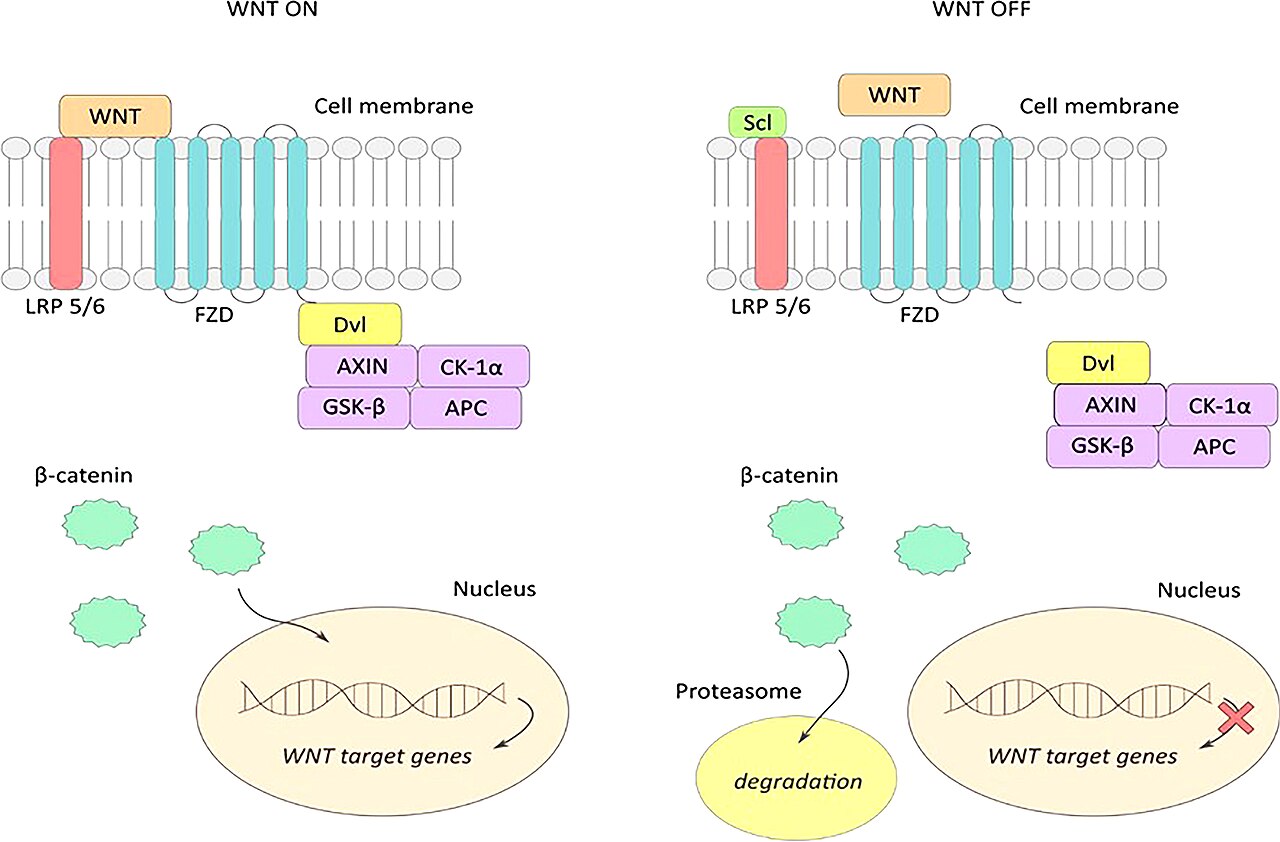
The basic mechanism: Wnt ligands (a family of secreted glycoproteins, 19 of them in humans) bind to cell surface receptors, triggering a cascade that ultimately prevents the degradation of β-catenin. When β-catenin accumulates in the cell nucleus, it activates transcription of genes that drive cell proliferation and differentiation. In the hair follicle, Wnt/β-catenin activity in dermal papilla cells drives the anagen (growth) phase. When Wnt signalling decreases, the follicle enters catagen (regression). The transition between these states is, at its core, a question of Wnt activity.
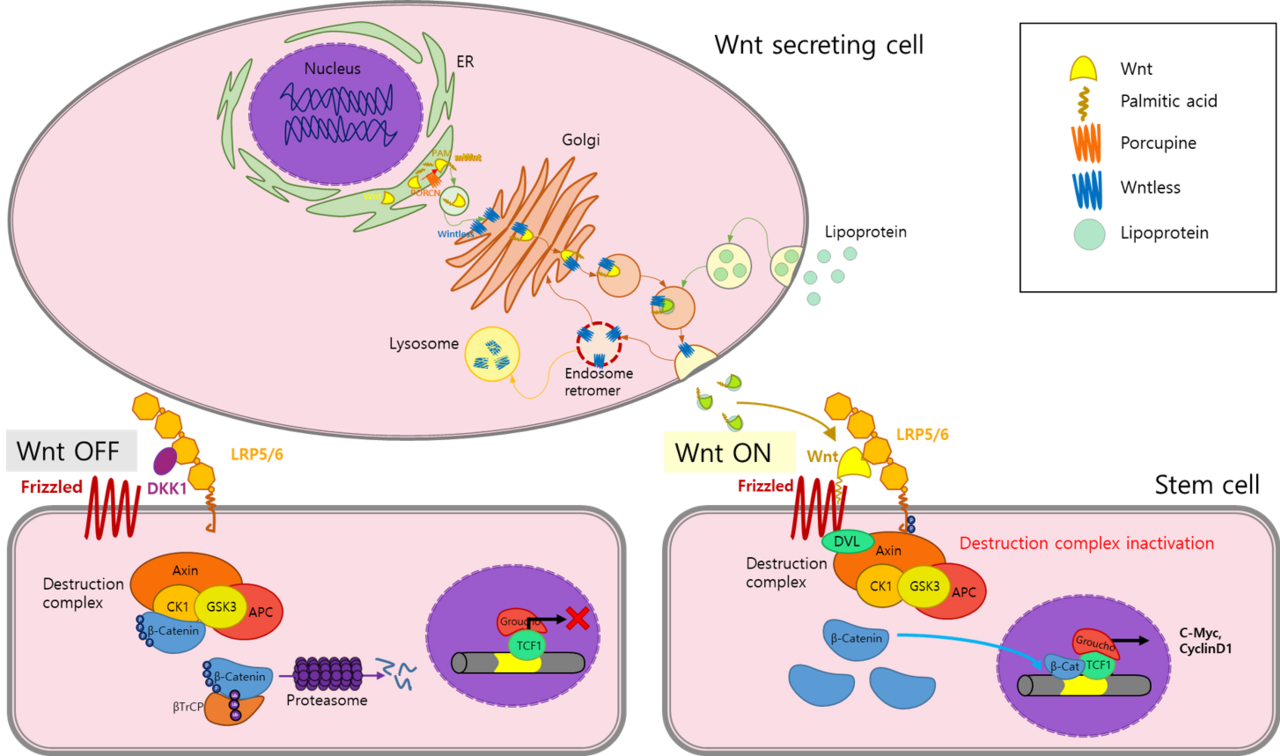
In androgenetic alopecia, the problem isn't simply too much DHT, it's that DHT-mediated signalling in genetically susceptible follicles progressively suppresses Wnt activity in the dermal papilla. A 2020 paper in Nature Communications showed that DHT treatment of dermal papilla cells in vitro caused dose-dependent downregulation of key Wnt target genes including VERSICAN and DKK-1 upregulation. DKK-1 is a soluble Wnt inhibitor produced by dermal papilla cells, it acts locally to suppress Wnt signalling in neighbouring epithelial cells and is one of the mechanisms by which DHT drives follicle miniaturisation.
This explains why targeting Wnt directly is so appealing. Rather than blocking DHT (which has systemic consequences), could you restore Wnt activity in the follicle and drive anagen regardless of the androgen environment? SM04554, the Wnt pathway activator developed by Biosplice Therapeutics (formerly Samumed), went furthest down this path, reaching Phase 2 trials before disappointing Phase 3 results in 2023. The Phase 2 data showed a statistically significant increase in non-vellus hair count. The Phase 3, run in a larger and more heterogeneous population, failed to meet its primary endpoint. This is a common outcome in drug development, and doesn't invalidate Wnt as a target, it highlights how difficult it is to activate Wnt signalling in a sufficiently precise, sustained way.
The most promising current approaches use Wnt activation not as a standalone treatment but as a component of combination protocols. When exosome preparations rich in Wnt pathway-associated proteins are applied to miniaturised follicles, the synergy with other growth signals appears greater than Wnt alone. Similarly, the stem cell conditioned media approaches currently in Phase 2 trials typically include Wnt ligands as a deliberate formulation component. The lesson from SM04554 may not be that Wnt is the wrong target, it may be that single-pathway activation is too blunt an instrument, and the follicle requires simultaneous input from multiple signalling axes to shift from miniaturisation to robust growth.
The 2026 landscape for Wnt-based therapy is one of recalibration rather than retreat. Several groups are now developing more sophisticated delivery systems, exosome carriers that present Wnt ligands in a membrane-bound form that more accurately mimics natural paracrine signalling. Others are exploring small molecule GSK-3β inhibitors (GSK-3β is a kinase that degrades β-catenin) with improved follicle penetration profiles. None have yet reached Phase 3. But the mechanistic rationale remains strong, and the field has learned from SM04554 what not to do.

Discussion (2)
DrewFromAustin
2 months ago
The SM04554 story is instructive. Phase 2 looking great, Phase 3 fails. That's the cautionary tale for every 'breakthrough' in this field.
Marcus T.
2 months ago
The combination approach makes more sense than single-pathway targeting. Follicle biology is too complex for a single switch to control it.
Join the discussion
Free account. Read, like, save, and comment on every article.