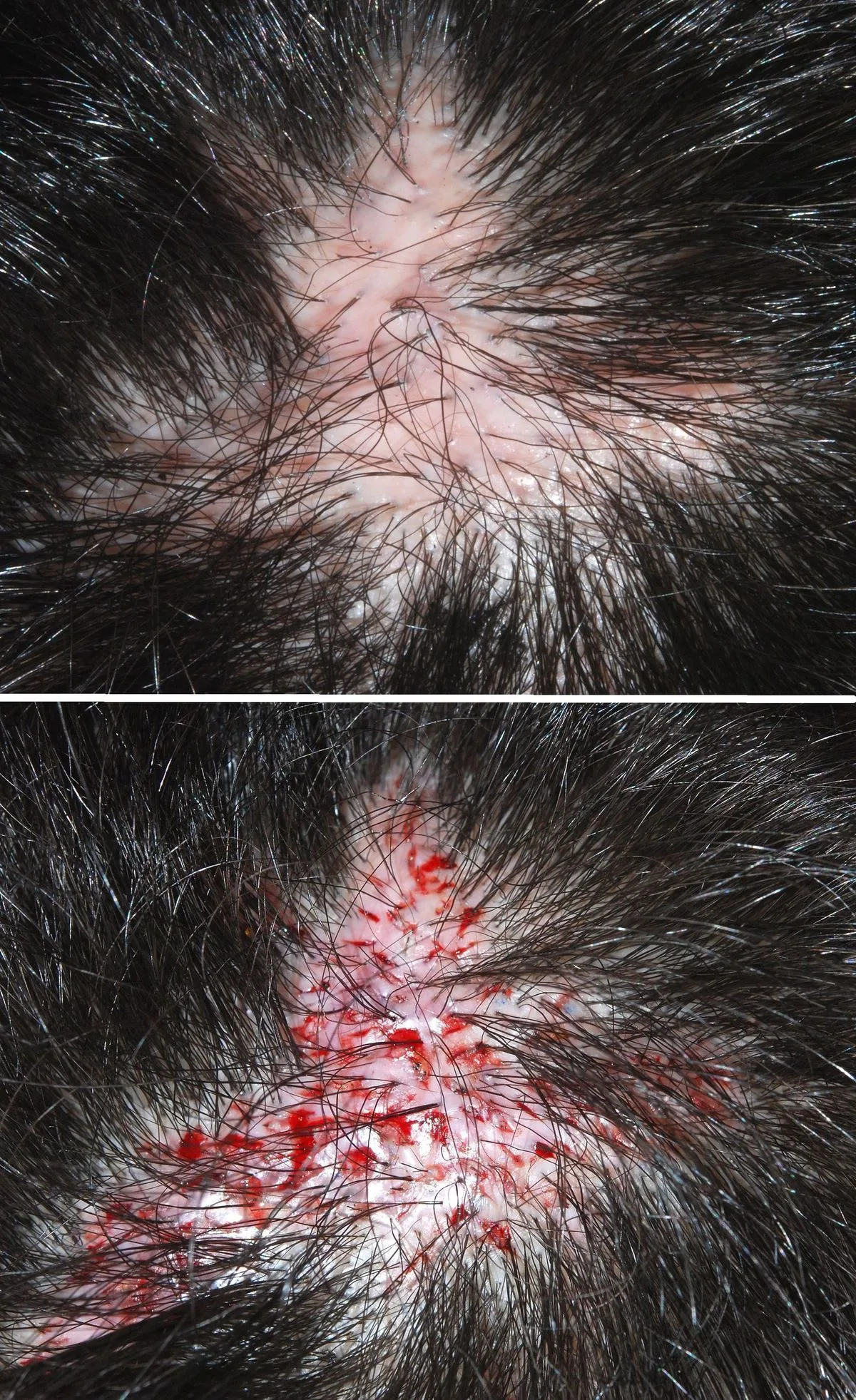
If you've seen old photos of men with hair transplants from the 1960s and 70s, you'll know exactly what I mean when I say the technique was, for decades, a cosmetic disaster. Those plug-style transplants, clumps of 10 to 20 hairs implanted in a regular pattern, looked like a child's drawing of hair, or a poorly seeded lawn. It took fifty years and several quiet revolutions to get from there to results that are now genuinely undetectable.
The story starts with Dr. Norman Orentreich in New York City in the 1950s. Orentreich made the foundational observation that hair follicles transplanted from the back and sides of the scalp, the donor area, retained their genetic resistance to androgenetic alopecia. This was the "donor dominance" principle: a follicle's behaviour follows where it came from, not where it ends up. This single insight made hair transplantation possible. Without it, transplants would simply have fallen out along with everything else.
But Orentreich's technique used 4mm circular punches that removed clusters of follicles together. These were the infamous plugs. They worked biologically, the transferred follicles survived and grew hair, but they looked artificial because nature doesn't arrange hair in regularly-spaced tufts. For thirty years, this was the state of the art. Patients were essentially choosing between visible baldness and visible bad transplant.
The first major refinement came in the 1990s with the development of follicular unit transplantation (FUT). Researchers including William Rassman and Bobby Limmer recognised that hair grows in natural groups of 1 to 4 follicles called follicular units. Transplanting these natural units, rather than larger arbitrary clusters, produced dramatically more natural results. The technique still involved excising a strip of donor scalp and dissecting it into follicular units under microscope, labour-intensive but a quantum leap forward cosmetically.
FUT remained dominant for over a decade. Its limitation was the donor scar, a linear scar across the back of the head that, while concealable under longer hair, was a permanent reminder of the procedure. For patients who wore their hair very short, FUT was problematic.
Follicular unit extraction (FUE) emerged in the mid-2000s through the work of John Cole, Ray Woods, and others. Instead of excising a strip, FUE extracts individual follicular units one at a time using small punches (typically 0.8 to 1.0mm). The donor area heals as tiny dot scars that are invisible at normal social distances even with very short hair. The trade-off was longer procedure times, lower extraction rates per session, and a learning curve for surgeons.
The most recent decade has refined FUE rather than replaced it. Robotic systems (ARTAS), better punch designs, improved graft preservation solutions, and dense packing techniques have pushed what's achievable in a single session well beyond what was possible in 2010. The current state of the art produces results that are essentially indistinguishable from native hair when performed well.
What hasn't changed: the technique still depends entirely on the donor reserve. Patients with extensive Norwood 6 to 7 hair loss face the same donor limitation today as they did in 1955. The exciting future technologies, follicle cloning, stem cell-based regeneration, promise to eventually solve this problem. But for the past seventy years and continuing today, hair transplantation has been the art of redistributing a finite donor resource as effectively as possible.
Looking forward, the historical pattern suggests that the next twenty years will see continued refinement rather than revolution in hair transplantation itself, with the bigger changes coming from biological approaches that work alongside or replace it. The technique that started with Orentreich's punch grafts has become extraordinarily sophisticated. It's also reached the limits of what surgery alone can do. The next chapter of this story is being written in labs, not operating theatres.
Discussion (3)
Marcus T.
5 months ago
I had a plug transplant in 1992. Living with that result for the first 15 years was difficult. Got it revised with modern FUE in 2018, the difference is night and day.
DrewFromAustin
5 months ago
The Orentreich insight is one of those things that seems obvious in hindsight but completely changed what was possible. Donor dominance is the only reason transplantation works at all.
Sophie L.
5 months ago
I'd love a follow-up piece on the women's side of this. Female hair transplantation has its own history and technical considerations that get less attention.
Join the discussion
Free account. Read, like, save, and comment on every article.